The recording you’ve just heard was broadcast live from the Cooma Ex-Services Club, late on the night of Wednesday January 13, way back in 1960.
The local Monaro Cricket Association team is set to play against an international side for the first time on the upcoming weekend, and, despite getting lost on the way through Canberra, their opponents have arrived.
The man being interviewed is Nat Uluiviti, the captain of the opposing side, and the fullback of his nation’s rugby team. Notice that he says he’s not much of a bowler. He would go on to take 11 wickets in this two-day match, which went down to the very last over.
But who was Uluiviti, and where did he and his teammates come from?
He was a part of an international team making its way around New South Wales that summer, a team that had beaten the West Indies in a tour match four years before, and would take on a New South Wales XI featuring Richie Benaud, Neil Harvey, Keith Miller and Alan Davidson on this very tour.
The team I speak of was Fiji, and this was a part of their greatest ever era as a cricketing nation.
A Fijian cricket team had visited Australia prior to this one, way back in 1908. A team of players from Bau Island, the chiefly centre of the nation in this period, played 26 matches, including games against New South Wales, Queensland, South Australia and Victoria. They won five, lost five and drew 16 of these matches, a handy effort considering that at the time Bau Island had an adult male population of around 60.
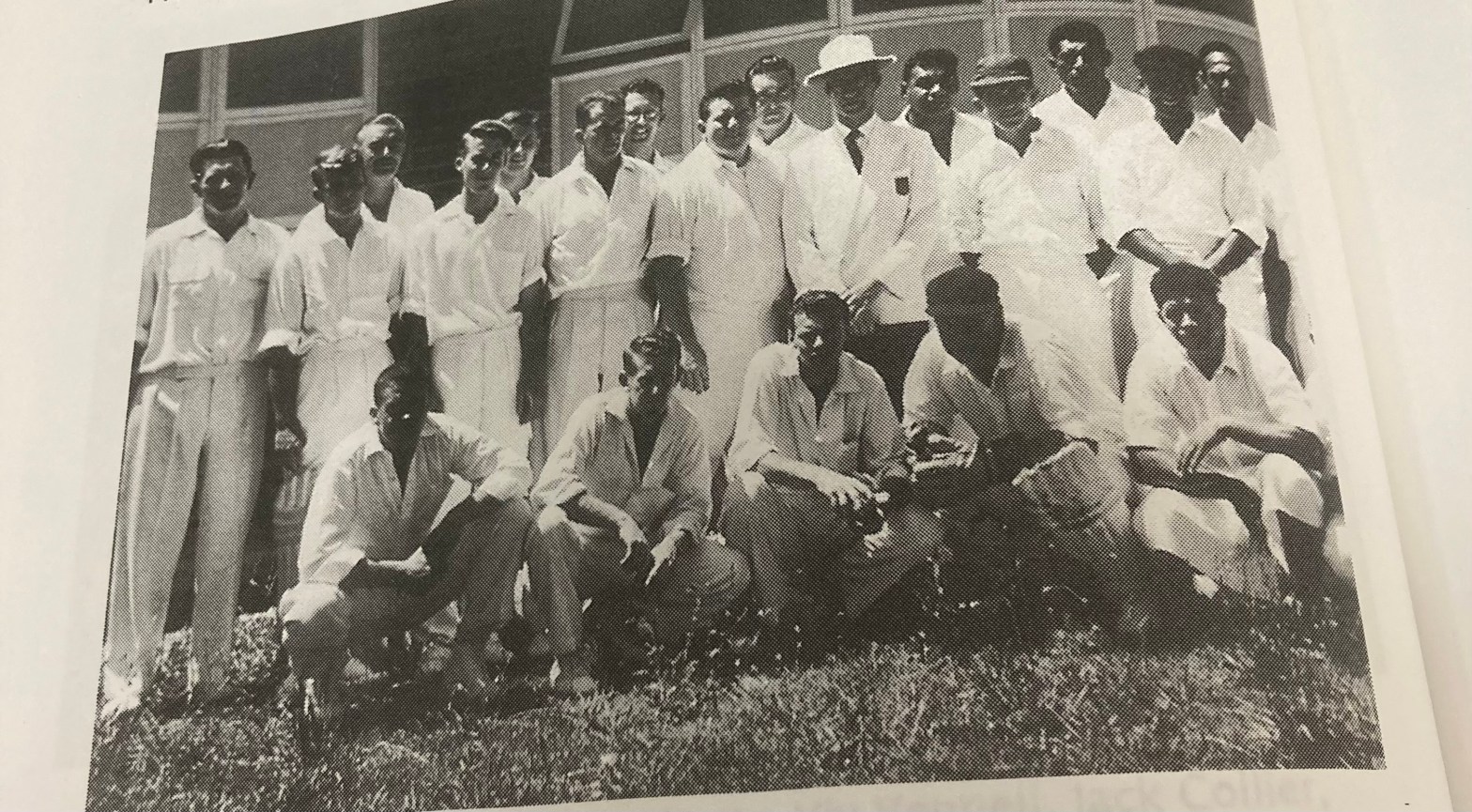
Just over 50 years later a squad of civil servants, planters, school teachers and a host of other professions touched down in Sydney to tour all over New South Wales. The team was made up of eight Indigenous Fijians, six Europeans and one Fijian Indian, and they came with an already established reputation as hard-hitting batters, fast skilful bowlers, and fantastic fielders.
Some of their most famed players included Uluiviti, Ilikena Bula, often referred to as the Fijian Bradman, who New Zealand tried to recruit in the 1950s, and Harry Apted, who also represented Fiji in hockey despite a childhood injury leaving his right arm permanently bent at the elbow, just to name a few. Jack Gosling was the tour manager, and he had been the hero of their win over the West Indies, taking six wickets including none other than Sir Garfield Sobers.
While they landed in Sydney and had a chance to practise at the SCG, their first match on tour was played at Woodward Oval in Parkes, about 350 kilometres west of the state capital. Here they played two matches, one against a team from the town and another against a combined New South Wales Central Western Districts team.
In this first weekend of matches an impression of the Fijian style of play and life was provided to their opponents. The Indigenous Fijian players all wore knee length white sulu skirts and were barefooted, and in the first match against Parkes a bowl of kava was brought onto the ground at the drinks break. Kava is made using the root of the native kava plant to produce a drink with sedative, anaesthetic and sometimes euphoric effects. Parkes opener John Fryer, battling along on 11 not out, was convinced to try some, perhaps with the hope of loosening up and increasing the scoring rate. However, Fiji’s star left arm seamer Asaeli Driu dismissed him with the very next ball, much to the amusement of the home crowd. Driu took 3-23 from nine eight ball overs, while Uluiviti took 6fa with his offspin, and Fiji went on to win the match by four wickets.
The next day the visitors needed to chase down their opponents second-innings lead of 60 inside 25 minutes. They needed only 13. Peak Hill leg spinner Laurie Scolari was given the new ball. Bula smashed a four and a six to start, before Uluiviti took charge. At the end of the first over the scorebook read 4,6,1,6,4,4,4,4. 0-33 at the end of the first over. By the fourth it was all over, a nine wicket win for Fiji.
This was T20 style hitting 10 years before even the first ODI had even been played. You could argue that New South Wales Central Western Districts were also trying modern tactics, opening the bowling with a spinner, but not quite as successfully.
They then moved on to Goulburn, where they recorded a six-wicket victory in front of the biggest cricket crowd in the town in ten years. They were three from three when they arrived in town, and despite Uluiviti saying they weren’t at their best yet, they weren’t going too badly either. Their next stop was Cooma, about 200 kilometres south.
At the time of this tour Cooma was in the midst of a boom of population, industry and development. The Snowy Mountains Hydroelectric Scheme was midway through construction, and with thousands of people from all over Australia and the world moving to the town and wider area, numbers in the local cricket competition were high.
Former Association President Tony Mackenzie moved to town in 1959, and here he reflects on the local area and team in this period. Unfortunately he was not in attendance for the Fiji match, but here he shares insights into the local social and cricket scene of the time.
The Monaro team was made up of Norm Deveraux, Mike Litchfield, Neville Galvin, Ferris Ashton, Bruce Kirkpatrick, David Coggans, Captain Clyde ‘Taffy’ Phillips, Jack Woodger, Aub Casson, Jim Alexander and Keith Scullin. Notable names in this team include Taffy Phillips, who Tony rates as the number 1 cricketer he’d seen on the Monaro, Norm Deveraux, an instrumental figure in restarting local cricket after World War II and Ferris Ashton, who represented Australia, NSW and Eastern Suburbs playing rugby league before moving to Cooma to work on the Snowy.
When the game began on January 16 1960 Monaro won the toss and elected to bat. Norm Deveraux and Mike Litchfield opened up for the hosts and put on a century opening stand. Mike still resides in Cooma, and while his memory of the match isn’t the clearest, he told me early last year that he does recall feeling in good touch before being run out for 34. Unfortunately for the hosts they went from 0/113 to all out 178 as Uluiviti took 6 wickets and Isoa Logavatu took 2, with Deveraux top-scoring with 67.
Monaro fought back with the ball however, and dismissed both Harry and Bill Apted, Ayub Dean, Petero Kubunavanua, Uluiviti and Osea Tuidraki to leave the visitors 6/111 at the close of play. They then came out red hot in the morning to bowl Fiji out for 133 and gain a 45 run lead, with Ferris Ashton, Aub Casson and Keith Scullin the best of the bowlers with three wickets each. Monaro went back out to bat and were carried along by 60 from Neville Galvin, with contributions from Taffy Phillips and Bruce Kirkpatrick getting them to 158 all out.
Fiji would now need to score 204 in two hours, and with a big crowd in attendance a tantalising ending approached. The Apted’s got them off to a flying start, putting on 68 before Bill was dismissed by Casson. Bula then joined Harry at the crease and they took the score to 100 in 55 minutes and passed 150 in an hour and 20. The pair looked imperious at the crease, cutting and pulling with freedom and stealing singles along the way. Eventually Apted was caught out for 88 with the score at 155, but they were well on track. The 600-strong crowd weren’t to know, but there was a collapse coming.
Ferris Ashton came back on and took the wickets of Uluiviti, Logavatu, Snowsill and Dean, all out bowled, while Scullin dismissed Bula and Tuidraki at the other end. Litchfield and keeper Galvin combined to run out Driu, and from 1-155 it had become 9-197 with seven runs required and time running out. Petero Kubunavanua and pacer Paula Sigeva were Fiji’s last hope, Monaro had the wind behind them to steal the match, and a draw was still possible.
Kubunavanua started to farm the strike, placing the ball around the Showground nicely. Then a slash for three from Sigeva in the last over brought the scores level. With four balls left and only a single needed the right man was now on strike. Kubunavanua was so quick on his feet and sharp with his hands that he once snuck up on a swallow that was getting in his way while fielding, caught it and put it into his sulu pocket. He blocked the ball into the offside, called Sigeva through and they scampered for a single to seal the win, with the Cooma-Monaro Express reporting that ‘the crowd and municipal band were left applauding a bright and fantastic finish to the match’.
Next stop after the nailbiter in Cooma was Bega, where Fiji played two one day matches and picked up two victories, with Harry Apted scoring an unbeaten hundred in the second match and being praised as the best batter to have ever visited the Imlay district. They continued further up the coast to Nowra, where they defeated Illawarra, bowling them out for 34 in the first innings, with Driu headlining by taking 7 wickets. This set the platform for a seven wicket win.
Next was St George in Sydney, where 40 degree heat scorched the players on a good batting wicket at Hurstville Oval. Former Test cricketers Arthur Morris and Brian Booth played for the hosts, with Booth and former NSW batter Raymond Flockton making hundreds in their score of 507. A highlight of this innings was Booth launching two sixes over a 10 foot concrete wall over long-on, with a barefooted IL Bula scaling the wall to retrieve the ball both times. Both Apteds and Tabualevu scored 50s in their reply of 303, which came at nearly a run a ball, while former Aussie leg spinner Bill O’Reilly picked up six wickets in a match that was eventually drawn. Ken Piesse notes in his book Favourite Cricket Yarns that some of the Fijian players entertained by opening cold longnecks with their teeth at the end of the day’s play.
The team then lost three games on the trot, struggling with the wickets and perhaps some fatigue in their matches at Newcastle, Quirindi and Barraba. By now they had played 10 matches of the tour, with the usual routine being two days on the field, and the following one spent travelling by bus or train to their next assignment, sometimes 100s of miles away. They continued to draw record crowds in the areas they visited, and would share the takings on the gate with their hosts to make the tour viable. They rekindled their winning form at Armidale, before enjoying a few days rest. They then defeated a NSW North Coast team at Grafton, picked up another win at Gosford, before returning to Sydney for their sternest challenge yet.
After 14 matches all over the state, the team returned to the SCG, where they’d practised upon arrival, to play a New South Wales Select XI in a one-day match. Almost 10,000 spectators line the stands. Fiji have made 163 in their first innings, and the New South Wales XI are under pressure. Test players Richie Benaud, Jim Burke and Norm O’Neill are all already out, as well as St George rugby league legend and first grade cricketer Reg Gasnier.
Keith Miller is still at the wicket however, one of the great all-rounders of his, and any time. While on 36 he skies one off Uluiviti. Fielding on the boundary, Inoke Tabualevu, as ever in his white sulu and in bare feet, sprints 40 yards, dives and takes the catch. Bill O’Reilly, a man who played 27 Tests and nearly 100 other first-class games writes that “without hesitation I class it as the greatest outfield catch I have ever seen.” Fiji go on to bowl NSW XI out for 137, and are declared winners on first innings.
The victory was celebrated on the front page of the Fiji Times, upstaged only by a photo of Queen Elizabeth, and the news of the birth of Prince Andrew. The Fijians were not afforded much time to celebrate, with a one-day game scheduled the following day in Orange. They fell away in pursuit of NSW Western Districts score of 277, being bowled out for 135.
The team were welcomed back to Fiji as heroes, with plans to improve pitches by upgrading from matting to turf and reciprocating the hospitality they’d experienced by hosting Australian touring teams. To have defeated a team that included six Baggy Green owners, some of them bona fide legends of Australian cricket, was a fantastic effort, especially being at the backend of a tour where they accumulated 3700 miles of travel around the state. In terms of stats, Asaeli Driu was the best of the bowlers taking 68 wickets at an average of 13.8, and Harry Apted topping the run scorers with 837. Captain Uluiviti was the standout player overall however, with 547 runs and 57 wickets for the tour.
So you might be wondering, what happened next for the national team, and to cricket in Fiji in general? Reciprocal tours were discussed while they were in Australia, but as Gosling told 2XL, this would not be easy, and that the tour overseas required a guarantor at home to get the tour going in the first place.
The rest of the 60s saw Fiji tour New Zealand twice, playing against their provincial sides, with varying success. Many players from the NSW tour were into their 30s and were no longer around, and those who replaced them were unable to reach the same heights.
In the 70s and 80s they had visits from Pakistan and England for one-off matches as part of Australian tours, but these were more for novelty and holiday than serious international clashes. They participated in qualifying events for every World Cup from 1979 to 2003, but never threatened as teams like Sri Lanka, Zimbabwe, Bangladesh, Kenya and The Netherlands made their way into the main draw, and into cricket’s wider conscience. Eventually they were usurped by Papua New Guinea as the main cricketing nation in the East Asia Pacific region, and they faded further back on the international stage. They made an appearance at the Under-19 World Cup in 2016, but were well out of their depth.
Scholar Narelle McGlusky notes in her excellent thesis ‘The Willow and the Palm: an exploration of the role of cricket in Fiji’ that “the weather and terrain frustrated the most enthusiastic attempts to promote the game. Rugby provided Fijians with a more compatible form of entertainment and excitement, dovetailing with current images of maleness and masculinity. Soccer gave Indo-Fijians a cheap leisure activity in which all could participate. Cricket remained a chiefly game and did not become popular with the general population.”
The last point McGlusky makes here is particularly interesting. Early Fijian cricket teams were filled with major political figures, such as Ratu Sir Kamisese Mara, the nation’s first Prime Minister. He toured New Zealand in the 1950s, and developed his game while studying at Oxford and in Waikato. He was supposed to tour NSW, but was a late withdrawal, with pace bowler Valentine coming in to replace him. Ratu Sir George Cakobau, the nation’s first governor general and Ratu Sir Edward Cakobau, who spent time as Deputy Prime Minister, were also former first class cricketers. When these figureheads became less involved with sport and more with the establishment of independent Fiji in 1970, cricket lost some of its main leaders. It’s worth noting that McGlusky’s work was published in 2005, five years before an organised national women’s cricket team even came into existence, hence the heavy focus on men’s sport in that quote.
This combination of becoming independent from the British, the geography and climate of the nation for producing more grounds and better pitches, and the fact that cricket, especially at top level, is an expensive sport that is not available to all, saw the sport stagnate. But that is not to say that passion for the game does not still exist around the islands of Fiji.
Back in August I was lucky enough to visit the Fijian national women’s team while they trained at Albert Park, the main cricket facility in Suva. With parliament house looming large behind them and the Grand Pacific Hotel standing proudly across the way, they were preparing to join PNG, Samoa, Cook Islands, Japan and Indonesia as well as hosts Vanuatu for a T20 World Cup qualifier. The balls were much more grey than white, pads, gloves and bats were shared as players changed over, but there was obvious talent on display. The seamers make the dead old balls jump off a length, and the sound when a batter middled one belied the tired willow in her hands.
Jone Seuvou coaches the Fiji national men’s team, and was filling in to coach the women’s team for the tournament in Vanuatu. Here he discusses the importance of tournaments like this, as well as the changes he’s seen in Fijian cricket over his lifetime, as well as his hopes for the future.
The trip to Vanuatu was the last for outgoing vice-captain Ruci Muriyalo, who has retired after being one of their main players with bat and ball for almost a decade . Ruci is now a Cricket Fiji development officer, one of a handful of staff charged with promoting the game all over the islands of her nation. She’s also from Lau, a cricket-mad chain of islands that produced Ratu Kamisese Mara, IL Bula and countless other figures of Fijian cricket. She speaks of the challenges and rewards of her work, and the breakthroughs that have been made in the female game.
Ruci’s comments about money, or lack thereof, coming in from the International Cricket Council could not be more timely. Last year a revenue model was approved as to how the estimated $600 million that the ICC earns annually would be divided and distributed. 38.5%, about 230 million dollars, will go to India. The other 11 Test playing nations will receive between 41.4 and 16.8 million each. The remaining 96 member nations, which include Fiji and , then share the final 11.19%, or 67.16 million. Distribution will vary from nation to nation, but on average that’s about $700,000 each out of the original 600 million, about 0.117% each. In fewer words and smaller numbers, 96 nations will share less than a third of what goes to India, cricket’s epicentre, and most commercially viable market. While cricket’s economic worth is booming, its opportunity to become a truly global game is going bust. Meeting Ruci put a face to this issue, and I don’t know how it will be solved.
Despite the talent shown on the 1959/60 tour and the promise it held for future relations, it was the last of its kind in Australia, and one of the final landmarks in the most successful era of Fijian cricket to date. Their big hitting was beyond anything going on in the Test world at the time, and their athleticism and attitude was always bound to draw a crowd. There is even a story from their game at Quirindi where fans were asked to be at the ground at 6am to clean up around the ground and surrounds before day two began, but found it spotless as the tourists had beaten them to it before they left the ground after Day 1.
But back in these times international cricket was a very exclusive club, and a remote nation with a small player pool, no real way to make money from cricket and a lack of infrastructure simply wouldn’t have fitted the requirements. Had more been done to help develop this, perhaps things would have been different. But times were different. Hell, South Africa were still one of the main three decision makers along with England and Australia at the time, and they would have simply refused to play them, as they did the West Indies, India and Pakistan and anyone with coloured skin in this period. Cricket just wasn’t ready for them. And sadly 64 years later cricket still isn’t ready for them, and yet, as I saw in the nets at Albert Park, the love lives on.
The legacy of the players involved on the NSW tour lived on long after they left Australian shores as well. Captain Nat Uluiviti went on to become a Senator, Harry and Bill Apted both went on to represent Fiji at lawn bowls once too old for competitive cricket and hockey. IL Bula is the only cricketer to ever be inducted into the Fijian Sporting Hall of Fame. Inoke Tabualevu was the coach of the national rugby team when they famously beat the British Lions in 1977. And Petero Kubunavanua featured on a commemorative 100 years of cricket in Fiji stamp in 1974, before even Sir Donald Bradman was immortalised in such a way. If anyone has one lying around, I’ll make them an offer.
The story of the 1959/60 Fijian team going from Parkes to the Paddington End, facing Benaud to playing at Barraba and from the Snowy Scheme to the SCG is one I’ve had great fun retelling, and I hope you’ve enjoyed listening.
Special thanks go to Access Officer James Dyer and his team from the National Film and Sound Archive in Canberra, station manager Mitch Hynes and his team at 2XL radio in Cooma, Talei and the sports staff at the Fijian Broadcasting Corporation, the archive team at the Fiji Times, my friend Joshua Nata for help with pronunciations, the NSW State Library, Jone, Ruci and Cricket Fiji and the Monaro’s own Tony Mackenzie. I would also like to thank the Federal Government’s New Colombo Plan, which gave myself and eight other students from the University of Wollongong an opportunity to travel to Fiji and Vanuatu in August-September last year.
My name is Russ Haylock, and thank you again for listening to Sixes in Sulus, my second audio feature. Photos, stats, further reading and other bits and pieces can be found in the show notes and on my website. Cheers.
 Russ Haylock Sportswriting
One thought on “Sixes in Sulus Script”