As they arrive for two Tests this Australian summer, I look back on the West Indies 1984/85 tour of Australia, where they played not only five Tests and over a dozen ODIs, but tour games from Wangaratta to the WA Wheatbelt, which I will look to revisit in this piece.
The West Indies will forever be remembered for their period of dominance in world cricket, especially throughout the 1980s, and by the time they embarked on their 1984/85 tour to Australia, they had established themselves as a global superpower in Test cricket. Many consider the West Indies 3-0 series win in England in 1976 as the beginning of this era of greatness, and in between that series win and the beginning of their ‘84 tour of Australia, the team had lost just five out of their last 59 Tests. They had also beaten Kim Hughes’ Australia 3-0 in the Caribbean earlier that year, with those memories fresh in the minds of the Aussie’s who would face them that summer.
This was a team brimming with players who remain firmly etched into the memory of those lucky enough to have grown up watching them, and other-worldly to those who rely on YouTube clips to understand their might. The team was led by Sir Clive Lloyd, and boasted a batting line up that starred Lloyd himself, Sir Vivian Richards, Richie Richardson, Sir Gordon Greenidge and Desmond Haynes. Their pace bowling battery was headlined by the late Malcolm Marshall, Michael Holding, Joel Garner and a young Courtney Walsh, with Winston Davis and Eldine Baptiste as reserves. Jeff Dujon took the gloves, with Thelston Payne as his back-up, while batters Gus Logie, Larry Gomes and all-rounder Roger Harper rounded out the squad. It is worth noting that a host of former Test players, such as Colin Croft, Alvin Kallicharran, Sylvester Clarke and Lawrence Rowe, were no longer eligible for selection after they were banned for life for touring South Africa two years before, where the Apartheid regime was still in full force.
The tour saw the team from the Caribbean play a total of 35 matches; Tests, ODIs, first class games and tour matches, some against country representative teams from across Australia. These matches saw the stars of world cricket playing at rural and regional venues in Western Australia, South Australia and Victoria, with local teachers, farmers, real estate agents and more going toe-to-toe with the best in the world, and fans able to experience greatness on their own home grounds. These are the stories of when the Windies came to town.
The Tour Begins
October 19, 1984: The West Indies first assignment on tour was a first-class match against Queensland, who were captained by Allan Border and included a host of Test players such as Kepler Wessels, Jeff Thomson, Carl Rackemann and Trevor Hohns. Craig McDermott, who would make his debut for Australia that summer, was also in the team. The match was heavily rain affected and ended in a draw, but allowed the West Indian pacers to find their groove, as Garner, Marshall and Davis combined for all ten wickets in Queensland’s first innings of 180 all out. Their batters found things more difficult, with Richie Richardson the only player to reach 50 in their only innings.
October 24: The next match saw the tourists travel to Loxton, a town that 3,000 people call home today, to play against South Australia Country. The town had played host to the West Indies once before, with their manager Wes Hall and other legends like Sir Garfield Sobers, Rohan Kanhai, Charlie Griffith and Basil Butcher turning out against SA Country when they toured Australia in 1968/69. Clive Lloyd, their current captain, was also a part of this squad.
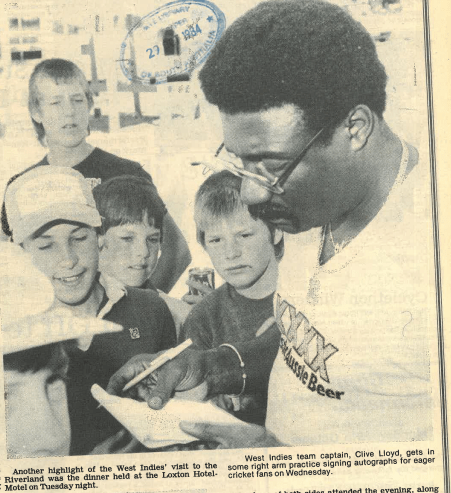
The Murray Pioneer reported that the team had flown from Brisbane to Adelaide via both Sydney and Melbourne, and after arriving in Adelaide had been bussed directly to Loxton, around 250 kilometres north-east of the state capital. After a dinner the night before they played in front of a crowd of around 7,000 people, who were treated to a thumping innings of 89 from Richie Richardson as the West Indies chased down 165 for the loss of just three wickets.
21 year-old Anton Gutsche opened the batting for the locals, and while he only made four he weathered the early storm of Holding and Davis before he was trapped LBW by Eldine Baptiste. He told The Murray Pioneer “they let a few go that I can’t remember much about. There were a couple of balls I tried to cut and the ball was in the wicket-keepers gloves before my back foot was in position!”
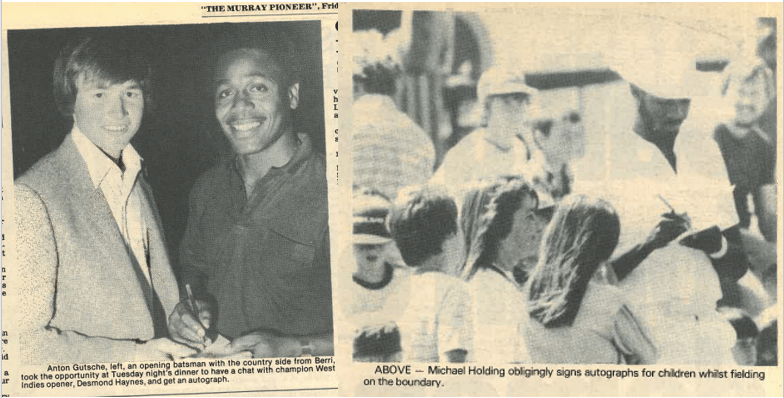
No top order player could get going against the quicks, however Country ‘keeper McCallum and pacer Penna put on 86 for the eight wicket to get the hosts to 165-8. After Richardson blazed the Windies to victory, Gomes, Logie and Payne all launched a few late runs as they batted on to entertain the big crowd and take their first win on tour.
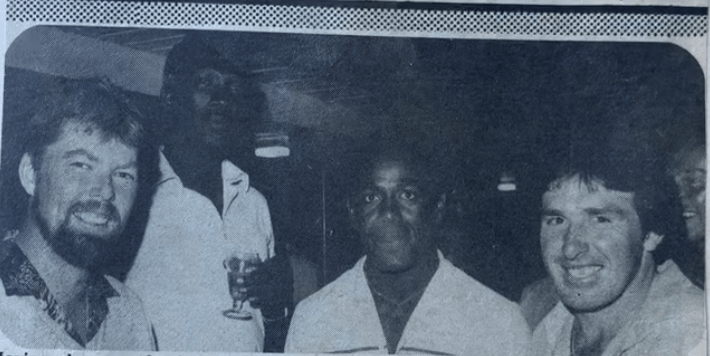
The West Indians popularity with local ladies is often mentioned when reflecting on this era, as shown by a reporter at The Murray Pioneer on Malcolm Marshall.

The team’s repeat visit to the Riverland was much appreciated by fans in the region, and allowed the team to begin finding their groove before the Test series, which would begin just over two weeks after this match.
October 31: Two days after playing out a draw against South Australia in Adelaide, the tourists were back on the park against Western Australia Country in Corrigin, a town with a current population of 700, 220 kilometres from Perth in the Wheatbelt region of the state. Aside from Clive Lloyd and Malcolm Marshall, the West Indians were close to full strength, and elected to bat first in the 40-over game.
Greenidge fell early for 10, and while Haynes, Gomes, Richardson and Payne all scored 25 or more, it was Gus Logie who wowed the bumper crowd of over 4,700 people, scoring 85 off 66 to get his team to 235 for 7. Viv Richards came in at number seven and heaved his way to 15, but was scarcely needed as they amassed a score that would be difficult to chase. Viv came into his own with the ball later on, taking 3-31, including WA Country captain Terry Waldron, while Desmond Haynes took three wickets and Logie two. The WA Country team did well to lose just one wicket to the pace attack of Davis, Walsh, Baptiste and Garner, but had to up the scoring rate and lost wickets to the medium pace of the bowlers as a result, as they fell 81 runs short of the target.
Pace bowler and dairy farmer Graham Manning missed out on the match with an injury, but was in attendance and had played against the West Indies at Albany three years earlier.
“We were rapt, just to be playing against them, and the joy of it all.
“It gave us a great experience, and we took that experience back to our own teams and our own levels. It helped our country sides, the fact that we could play against these teams and have younger cricketers push to try and be in those teams.”
Being granted the opportunity to play for WA Country three times between 1981 and 1984 is an honour Graham is proud to have to his name, and while injury spoilt his chance to play in the match at Corrigin, he does have plenty of fond memories to look back on, such as riding with Richie Richardson in a vintage car during a parade in Bunbury, being starstruck when he was smacked for six over cover by Zaheer Abbas in Northam, and winning the fielding award, presented by Clive Lloyd, at the end of the match in Albany.
With the Corrigin game won, the touring team moved on to Perth for a first-class match against Western Australia. Despite a good start of 3-317 declared in the first innings, and following it up by bowling their opponents out for 302, they were demolished in their second dig for 111 all out by Walsh (5-60), Holding (3-26) and Davis (2-23). The batters then chased the 127 they were set for the loss of just one wicket, sending an ominous warning shot to the Aussies ahead of the First Test at the WACA.
Success in the Tests
November 9: The First Test saw Australia blown away by an innings and 112 runs, as the West Indies pacers well and truly hit their straps to bowl them out for 76 in their first innings. Michael Holding took 6-21 in less than 10 overs, while Marshall and Garner took two each in the demolition of Australia’s line-up. This came after their batters, notably centurions Gomes (127) and Dujon (139) steered them to a score of 416 in the first innings. In-form Courtney Walsh wasn’t required in the first innings, but he joined in the second, picking up two wickets as Australia were bowled again out for 228. The result still remains their fourth heaviest defeat on home soil, and their second heaviest in the past 110 years.
November 23: The pressure that had been mounting around Australian cricket came to a boiling point at the end of the Second Test in Brisbane, culminating in Kim Hughes’ resignation of the Australian captaincy, and the subsequent appointment of Allan Border. Despite the fact that New South Wales had defeated them in the week leading up to the match, the West Indies recorded their tenth straight Test victory, setting the match up in the first innings, bowling Australia out for 175, then scoring 424 in their first dig. This came on the back of two centurions; Richardson (138) and Lloyd (114) doing the majority of the runscoring. Their quicks then dismissed Australia for 271, with Marshall’s five-fa trumping half centuries from debutant David Boon, ‘keeper Wayne Phillips and opener Kepler Wessels. That left the West Indies with just 22 to get, which they did, stretching Australia’s winless run to seven consecutive Tests.
December 7: After playing out a draw against Victoria, the West Indies travelled to Adelaide for the Third Test. Their golden summer rolled on into this clash, as they wrapped up the series despite the all-round efforts of Aussie seamer Geoff Lawson. Lawson took 8-112 in the West Indies first innings of 356, which included 50 plus scores from Greenidge, Gomes, Lloyd and Dujon, before hitting 49 with the bat and taking three more wickets in the second innings. Kepler Wessels also had a standout match, scoring 98 and 70 despite the struggles of his top-order counterparts. Despite these efforts, Malcolm Marshall ran riot once again with two more five wicket hauls, while Larry Gomes’ second hundred of the series allowed them to declare and set Australia a near impossible chase of 364, which they fell 191 short of to hand the Windies their 11th straight Test win.
December 19: The next stop for the team was Echuca, a town built on the banks of the Murray River in Northern Victoria. They had played out a draw at Devonport on the north coast of Tasmania just days before, and were ready to take on Victoria Country. The match was played at Victoria Park, a venue that had hosted the touring New Zealanders in the early 1970s, however this was expected to be the day of days for cricket in the town.
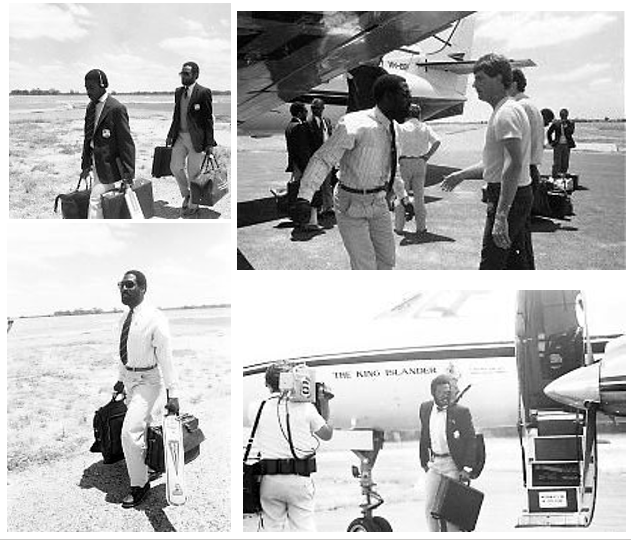
Over 400 people welcomed the West Indies when they flew into Echuca, and around 5,500 attended the match, which was highlighted by the skill and sense of humour of the tourists. The West Indies batted first, with Haynes, Dujon and Richardson getting them off to a decent start, but it was Viv Richards who gave the crowd something to best remember, hitting two towering sixes, both straight down the ground and into the neighbouring tennis courts. It was written afterwards that after one of these sixes Viv turned to his partner and remarked, “[just a] nine iron onto the green.” Number eight Eldine Baptiste then smoked 75 to get their score to 279 from 50 overs. In reply Deniliquin batter Steve Bray made an unbeaten 96 as the country team gave the chase a good shot, reaching 4/215 at the end of their allotted overs.
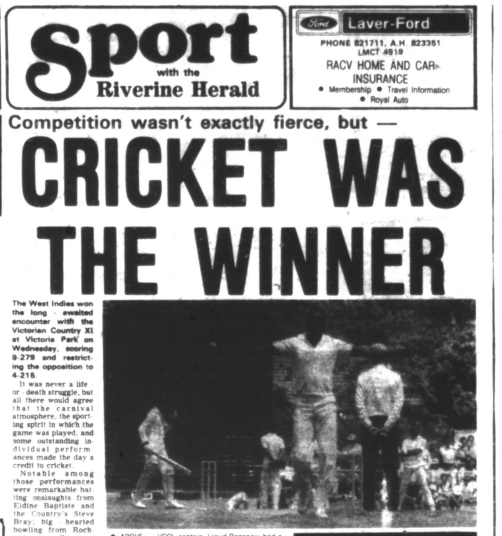
The Riverine Herald‘s cadet reporter Paul Jacobs was 12th man for the match, and he wrote at the time that “my experiences with the West Indies players were like one big dream” and that “the enjoyment and joy I received out of meeting such sporting luminaries will remain with me forever.”
Prior to the match a dance had been held at the Echuca Workingmen’s Club, and with a West Indian Steel Band performing the players were all happy to dance and socialise with the locals, allowing more than just the match to live on in local folklore from the West Indies visit to the country town.
December 22: Before the Fourth Test it had been a quiet tour for Antiguan batting king Sir Vivian Richards, but three days after he was hitting sixes into the tennis courts in Echuca, he was belting his way to a 245-ball 208 at the MCG. The team were 6-223 when Clive Lloyd was dismissed in the afternoon session on Day 1, but Richards dug in, then hit out, and was eventually the last dismissed with the scoreboard reading all out 479. Often throughout the series Australia had reduced the West Indies to similar positions, but someone, this time Richards, had stepped up to thwart their attacks. Marshall then took his fourth consecutive Test five-fa as Australia were dismissed for 296, with Wessels and recalled opener Andrew Hilditch scoring 90 and 70 respectively. The West Indies were still on track for 12 in a row, however Lloyd waited until early on the Fifth Day to declare and set Australia a target of 370. The Aussies then survived for a draw thanks to 113 from Hilditch and the rearguard efforts from tail-enders Bennett and Lawson to remove the chance of a whitewash on home soil.
December 30: The Test series closed and the New Year opened with an upset Australian win in the Fifth Test. Kepler Wessels once again stood up, scoring 173 alongside contributions from most batters, and a helpful 44 extras, to get his team to 471 all out. While Australia went with spinners Holland and Bennett, Harper was left out for the West Indies as they favoured their trusty four quicks. It was Holland and Bennett who would star for the Aussies, taking 13 wickets between them for the match as they bowled the West Indies for 163 and 253, handing them their first Test loss in more than three years. It was also Clive Lloyd’s 110th and final test for the West Indies, concluding his career with the 3-1 series win in Australia.
Wonderful in the One-Dayers
January 6-27, 1985: Once the Tests had concluded, the ODI tri-series with Australia and Sri Lanka began. Between January 6 and 27 the West Indies played, and won, nine ODIs, five against Australia and four against Sri Lanka, as well as beating the Prime Ministers XI and ACT in Canberra. The win in the PM’s XI game was arguably the hardest fought in this period, with Allan Border scoring 114 for the home team as they came up just 15 short in their chase of 284.
January 29: From Canberra the team travelled to Albany, a town with a population of less than 15,000 at the time, to play another one-day match against WA Country. The match was played during a three day retreat for the travelling team, who had played in Albany in late 1981 in front of a crowd of more than 5,000 spectators. Haynes, Logie, Gomes and Dujon played their second match on Centennial Oval, which was won by the West Indies, but highlighted by a fearless innings of 72 in just 39 minutes from WA Country captain Terry “Tuck” Waldron, an innings praised in The West Australian newspaper soon after.
“Jovial Kojonup real estate agent Terry Waldron yesterday did what no other Australian batsman has been able to do this summer – unmercifully flay the West Indies attack.”
The West Australian, January 30
Waldron’s innings came in the home side’s chase of 238, which they fell just 11 runs short of. Waldron had smacked 76 against the West Indies in Bunbury just a year earlier, an innings that remains firmly instilled in country cricket folklore in the west. Other highlights included Courtney Walsh’s wild-armed leg spin bowling and Richie Richardson’s classy innings of 75 earlier in the day, as a rowdy midweek crowd of 4,000 enjoyed another visit to the south coast of WA from the all-conquering Caribbean outfit.
February 2-12: After the Albany encounter, the Windies completed their flawless run in the round robins with another win over Sri Lanka in Perth. They would then face Australia in the best-of-three finals series, where they lost the first match thanks to an unbeaten 127 from Allan Border, before bouncing back to win the next two finals. Australia were on top at times in the second final, and were beaten only by an excellent partnership from Gus Logie and Jeff Dujon as the West Indies chased them down, before they were thumped in the decider thanks to a five wicket haul for Michael Holding, and fifties to Haynes and Richards.
February 19-21: Later in February, the rest of the seven Test nations from the time; England, India, Pakistan and New Zealand, joined the West Indies, Sri Lanka and Australia Down Under for the Benson & Hedges World Championship of Cricket. The one-off tournament saw the West Indies, who were the favourites, placed in a pool with Sri Lanka and New Zealand. They would play a match each against these teams, and the top two teams would go through. Their first match was supposed to be held on the four month anniversary of the tour beginning in Brisbane, but it was rained off, as was the second attempt to play the match on the reserve day. They would resume their campaign here after a quick stop-off in northern Victoria.
One Last Trip to the Country
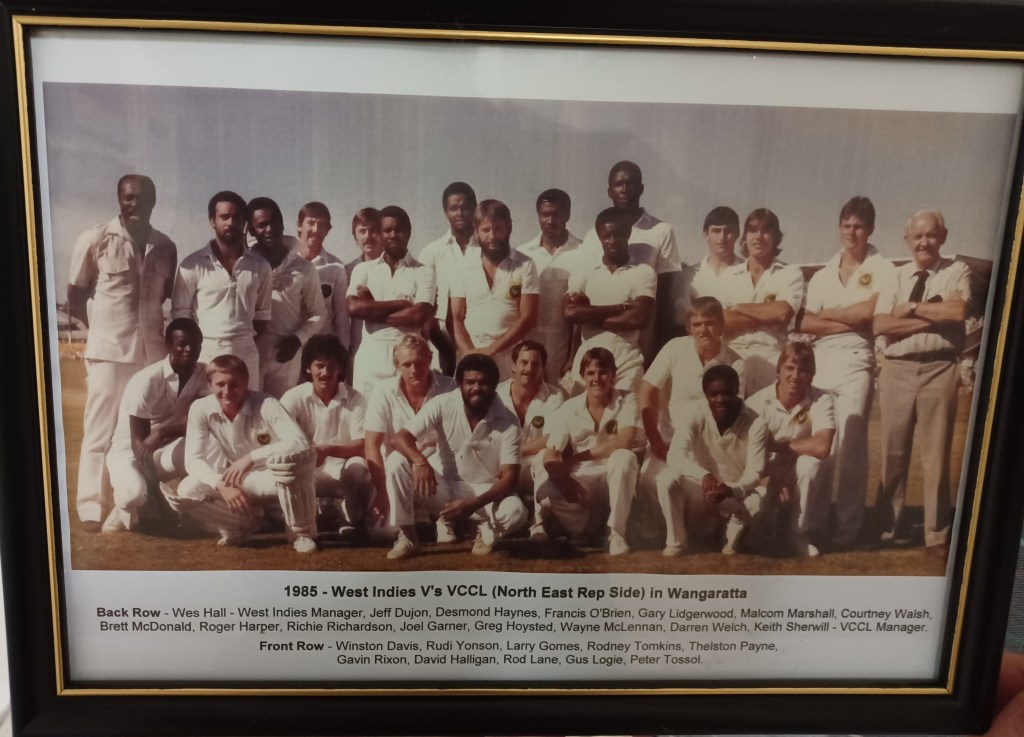
February 24: From Melbourne, the West Indies made their way to Wangaratta, just under three hours north-east of the state’s capital. They were back in the region for the second time inside 14 months, after playing a match against Victoria Country at nearby Benalla between matches of an ODI tri-series in the previous year. As was the case in Loxton, manager Wes Hall and captain Clive Lloyd had also visited in 1968/69.

This time around they would take on North East Victoria Country, with Wangaratta cricketing veteran and current association president Greg Hoysted opening the batting for the country boys. A welcome barbecue was held, with Greg recalling a very “social” night with the visitors.
“It turned into a very big night the night before for a lot of them. I think it was a bit of a blowout for some of them, so for instance ‘Dessie’ Haynes was very very second-hand the next day and he got a duck.”
The West Indies batted first, with Haynes the first man out to captain and Wangaratta fast bowler Gary Lidgerwood, who also took the wicket of Thelston Payne to leave them 2-10 early on. With plenty of grass left on the wicket there was movement on offer for the opening bowlers, and while Greg, who was just 23 at the time, was aware that Davis, Walsh, Garner and Marshall would get to return serve later on, he was pleased with the team’s start. Richie Richardson and Gus Logie came out with a goal of entertaining the capacity crowd of 10,000 that had gathered, with Greg recalling a six that Richardson hit just before his dismissal.
“‘Wang’ Showgrounds is a big ground, so the boundary itself would have been between 65 and 70 metres, then there’s a cycle track, so that’s another 10 metres, then the fence, and then the public walkway, another 10 metres, then you’re into the grandstand, and the grandstand by country standards is quite a big building, so he’s picked a ball up off his pads and hit it into the top deck of the grandstand.”
Dujon was then dismissed for a duck once Logie and Richardson had been removed, reducing the tourists to 5-94. This brought Roger Harper and captain for the day Larry Gomes together, with Gomes focused on not slipping up against a country side, while Harper was eager to impress after spending much of the tour outside of the team. They put on 145, and helped them to 291 all out, with Harper finishing with 103 and Gomes 72.
After spending the innings in the field Greg knew he’d be out there straight away, and after electing to take strike he recalls clearly having Winston Davis running in to deliver what Greg thought would be the first ball, however the big Vincentian ran in at full pace, whipped through his action, but did not release the ball, much to the batter’s bemusement.
Despite this Greg and Francis O’Brien, who had captained Victoria Country against the Windies at Benalla, knuckled down and saw off five overs each from Davis and Walsh, but not without plenty of difficulty on the green wicket.
“[Courtney Walsh] decided that it was a bit disrespectful that I wasn’t wearing a helmet, so he only bowled basically one ball in my half the whole spell.
“The one time he tried to pitch up after he’d had enough of that he thought he’d try and bowl me, so he bowled one full ball, but with his action it slid down leg-side. It hit me on the pad, and after I was out and I got in and took my kit off there was a bruise in the middle of the shin.”
After the opening assault the job became a little easier for Francis and Greg, facing the medium pace of Richardson and Logie, before calls for “Big Bird” Joel Garner to have a bowl came loudly from the crowd.
“The crowd started to chant for Joel, so Joel came on and bowled off-spin, and I was on 44 so I thought, this is the only chance I’m ever going to get, I’m going to try to hit Joel Garner back over his head for six to get to 50, so I ran past one coming down the wicket and Jeff Dujon stumped me, so I reckon I might be one of the only people in world cricket who can say they’ve been out stumped Dujon, bowled Garner!”
After Greg’s dismissal only one more wicket fell, as Gavin Rixon, brother of Test cricketer and ‘keeper Steve, and Peter Tossol, who played 17 matches across three VFL seasons at the Melbourne Demons, came together at the crease. The pair put on 121, despite Tossol suffering an injured finger when Walsh came back on to bowl, as they fell just 17 runs short of the target of 292.
As a young man taking his cricket very seriously, but unable to take an opportunity playing with Melbourne University in Premier Cricket due to commitments on the family farm at home, and his teaching career, these opportunities were golden for Greg and his teammates.
The coach of Melbourne Uni had come to me and said we want you to play… we want to start you in the seconds and we’re hoping to get you in the firsts. And I had to say to him, it’s a really good offer, but I’ve got the chance of playing against the West Indies, so I turned him down to stay in the country.
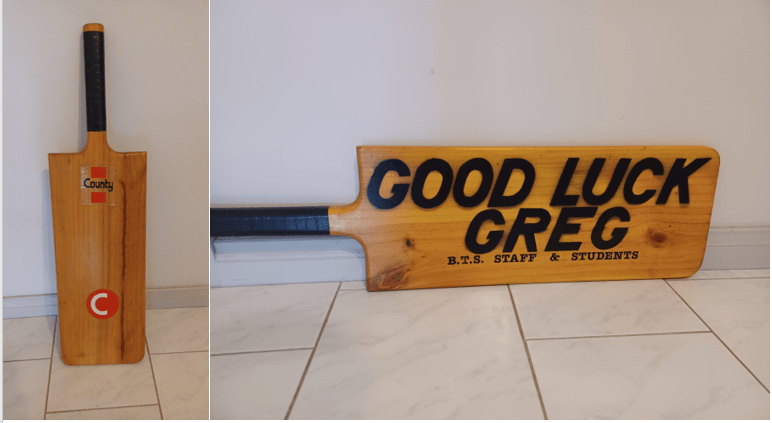
It was through these opportunities to play against the West Indies in 1985, Zimbabwe in 1994 and for a fully-fledged Victoria side in the 1994/95 Country Championships, as well as his efforts as an A Grade batter for Benalla to this day, that helped him to be selected for Australia in the inaugural Over-60s World Cup. Australia came third in this competition, with Greg having the opportunities to swap stories about Joel Garner with South African Over-60s manager and legendary all-rounder Mike Procter, showing the everlasting nature of getting to face the players of this particular West Indies team, as Procter did in County cricket while South Africa were exiled from the international game.
The match against the West Indies led to plenty of positive movements for cricket in Wangaratta. The town hosted a Sheffield Shield match between Victoria and Queensland in 1986, as well as hosting domestic one day cricket, leading to an uptake in participation and interest in the sport that reached record levels in terms of local teams and competitions. While this number may have reduced with time, Greg and his teammates still nod to the touring West Indies for their part in developing the sport in the region, and themselves as individual cricketers, as a result of playing in this match.
February 27-March 9: The team returned to Melbourne, where they comfortably beat Sri Lanka, despite the pace of Rumesh Ratanyake, who hit Richardson and Gomes and forced them to retire, before they were beaten by Pakistan in the first semi-final. They bounced back to beat New Zealand in the third-place final, concluding the tour with a six wicket win.
On cricket schedules, tour games, travel and “too much cricket“
There has been plenty of discussion recently about the schedule of international cricket, and the meaning behind a lot of matches and series that are played. Take England’s Moeen Ali’s words on their recent three match ODI series, for example, where he called the schedule “horrible”, as the team were back on the field only four days after winning the T20 World Cup. I believe there are huge issues with the next Future Tours Programme, but that’s for another day.
The West Indies have been afforded two warm-up matches for this year’s tour, which is more than can be said for Australia’s other visitors this summer, South Africa, who are yet to have scheduled any tour matches prior to the First Test on December 17. While on tour in England earlier this year, South Africa waived opportunities to play tour games in favour of playing golf, and also waived ODI Super League points and put their automatic World Cup qualification in jeopardy by pulling out of the scheduled ODI series against Australia this summer to prioritise the new SA20 league at home. All these series, leagues and qualification systems usually point to one phrase; “there’s too much cricket”. And for the world’s best, this is true. For Associate cricketers, women’s cricketers and cricketers with disabilities, less so.
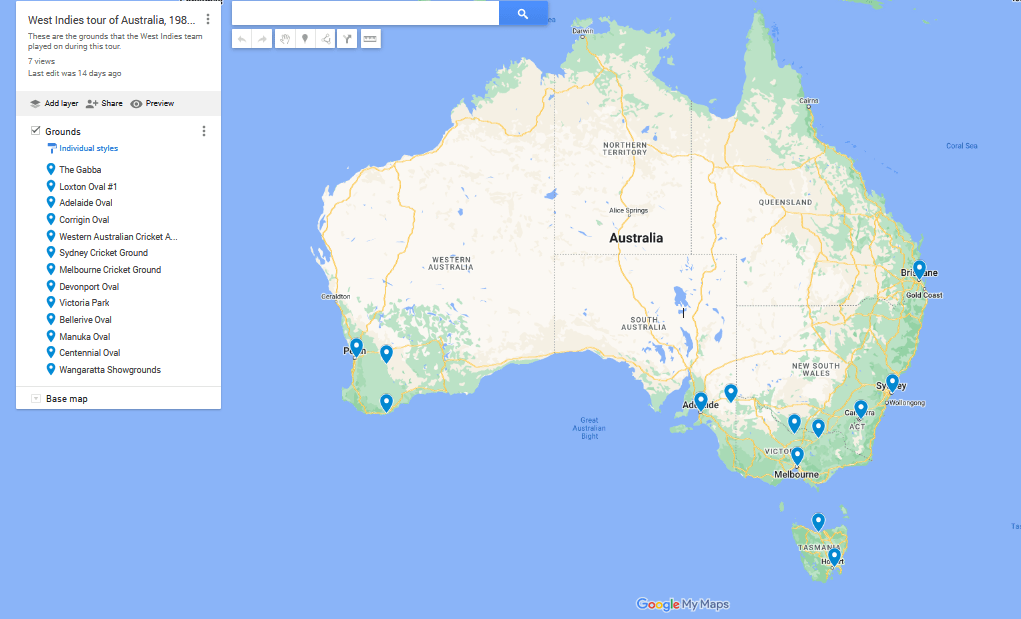
On the 1984/85 tour, there were 141 days between the West Indies first and last match, with 73 days of cricket scheduled in this period across 35 matches in 13 different cities and towns, as shown on this map. That is an astounding amount of cricket, and travel, especially when you consider the workload placed on particularly their fast bowlers.
It was a different era, but you could argue that this was also “too much cricket”, and that the country games were unnecessary, however the fact that they happened is worth celebrating, and the stories that go along with this tour and many others are such important parts of country cricket folklore that they deserve to be told. For aspiring young cricketers to have been able to stay in their home communities and play such opposition is special, and I hope this has been reflected in this piece.
Where are the Windies now?
Many of the West Indian players from this tour have remained involved in cricket after their playing days, such as Desmond Haynes, who is currently head selector of the West Indies, a role that was previously occupied by Roger Harper. Courtney Walsh is now the coach of the West Indies women’s team, a role formerly held by Gus Logie, who remains a key figure in the game in Trinidad and Tobago. Joel Garner has spent time as a selector and manager of the senior men’s team, Jeff Dujon has also been involved as an assistant coach, and was also instrumental in developing their players union at the back end of his career. Before his tragic passing at the age of 43, Malcolm Marshall served as coach of the West Indies and of Hampshire, before losing his battle with colon cancer. May he rest in peace.
Gordon Greenidge’s successes as coach of Bangladesh in the 1990s saw him receive honorary citizenship in the Asian nation, while Larry Gomes spent time as coach of Canada in a similar era. Eldine Baptiste also spent time as an international coach with Kenya, before returning to the Caribbean for a stint coaching the Leeward Islands.
Richie Richardson is currently an ICC match referee, a role that Clive Lloyd performed for over 180 international matches after his playing days. Viv Richards has been used as a mentor for the Quetta Gladiators for the past six PSL seasons, while Michael Holding became one of the most trusted and well-renowned voices of cricket through his commentary, and only recently stepped away from the role.
Winston Davis became a quadriplegic after an accident falling out of a tree while working on the construction of a church in St. Vincent, and has had a number of benefit matches played in his honour to improve his quality of life since the accident.
Thelston Payne is renowned as the most prolific batter in the history of St. Catherine Cricket Club in Barbados, where he still lives today.
Edit: Payne has passed away since the writing of this piece, succumbing to a lengthy illness in May 2023.
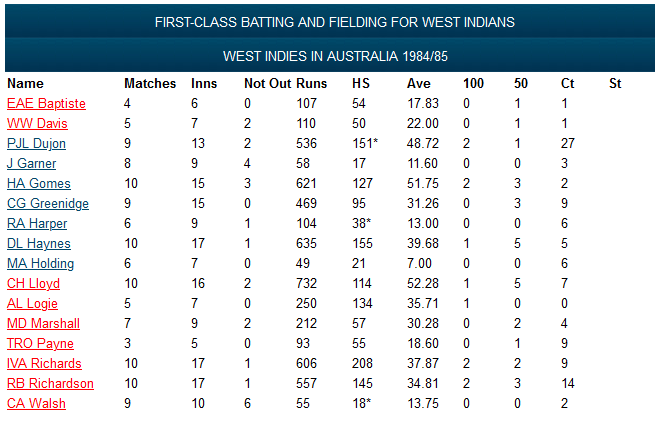
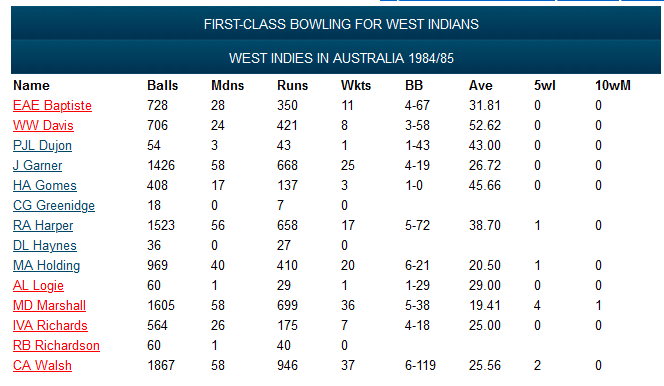
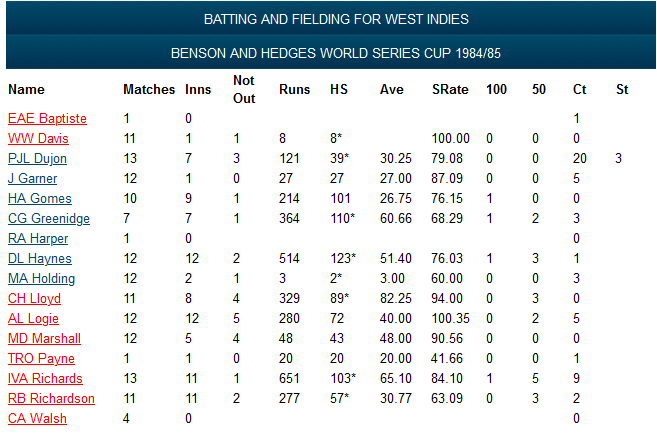
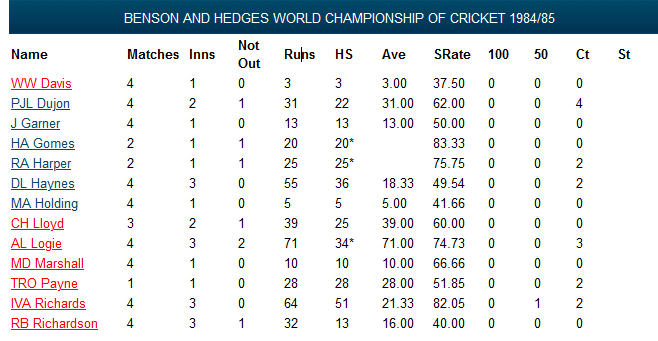
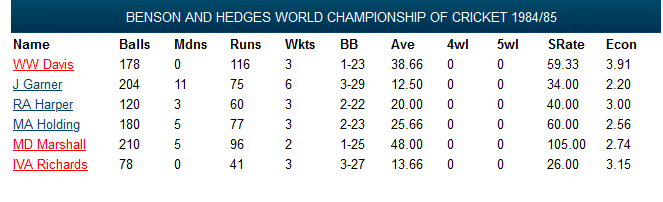
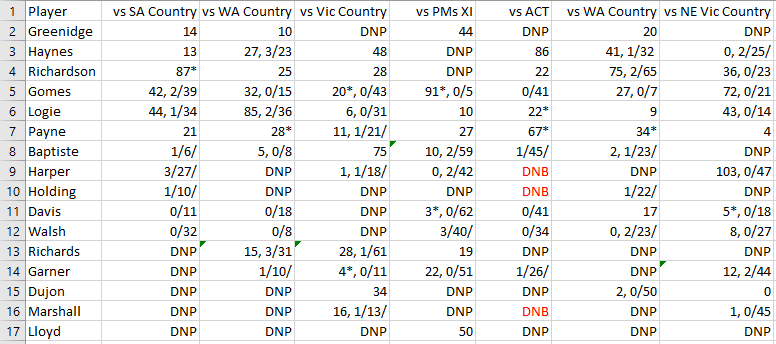
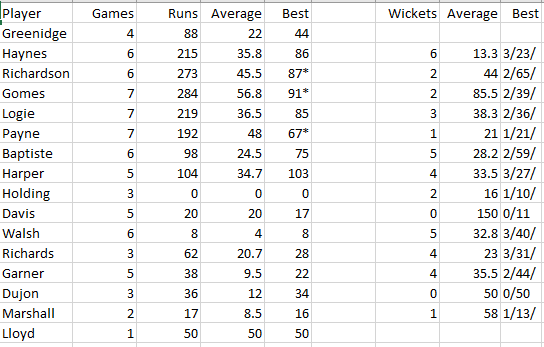
Statistics (First Class, B&H Tri-Series, B&H Championship of Cricket, Tour Games)

Special Thanks: Echuca Historical Society, The State Libraries of South Australia, Western Australia and New South Wales, The Riverine Herald, The Murray Pioneer, The West Australian, The Wangaratta Chronicle, Rob Marshall and the Western Australian Country Cricket Association, Nathan Thompson, Greg Hoysted and Graham Manning.
About me
My name is Russ Haylock, I’m a journalism student at the University of Wollongong, and if you have more to add to this story, or something similar, please contact me via my email, which is russhaylock407@gmail.com. Feel free to share this with your friends via social media as a written or audio piece, and I look forward to bringing you more content in the future. Cheers!
 Russ Haylock Sportswriting
One thought on “When the Windies Came to Town: The Australian Summer of ’84/85”