This report aims to introduce the niche of cricket writers on Substack to a new audience, and the ways in which different creators reach an audience in traditional and new ways. In this report, the autoethnographic methods undertaken across the semester will be discussed, and how it can assist in the creation of a persona for the individual audience member. In addition, the epiphanies that have arisen will be discussed, and related sources and skills that have allowed me to compile this introduction to my niche. While cricket contains a lot of jargon, I will attempt to boil down some of the specifics of the writings I have studied to make them more understandable to a broad audience and link them to the ethnographic theory we have been researching. These are the basic objectives that will guide this report on old and new style online cricket writers, focussing on newsletter platform Substack.
Beginning my thought process for this project with cricket writing and cricket media as a whole, narrowing to cricket writing on Substack specifically, was the process that allowed my niche to be defined. This is a platform that can be used to write any kind of digital newsletter, but looking specifically at the creators on this particular platform gave me a place to begin from. It is worth noting that cricket writers on Substack are nearly exclusively independent, and use the platform as a place to write opinion pieces related to matches that have been played recently, or series between two teams that are in progress. My choosing of Jarrod Kimber, who I consider to be a new-age cricket writer, and Neil Manthorp, who I see as more old-school, was an important narrowing process. It is important to explain clearly the meaning of this assertion; Kimber is a multi-platform, always innovating writer, whereas Manthorp uses a strong historical knowledge to write pieces for traditional sources, and the two overlap in their use of Substack for their opinion pieces.
What I was able to create in this subject was primarily autoethnographic, using my knowledge base to compare and contrast writing styles and journalistic methods and explain them to a broad audience. Carolyn Ellis’s work “Handbook of Autoethnography” became a crucial text I engaged with to relate the theory to my niche. She describes autoethnography as “not simply a way of knowing about the world; it has become a way of being in the world, one that requires living consciously, emotionally, reflexively. It asks that we not only examine our lives but also consider how and why we think, act, and feel as we do.” Furthermore, it was my goal to remain aware of academic writing in the field of online sports journalism. LaTrobe University’s Narelle Harris notes that “the instantaneous, intimate and interactive nature of social and mobile technologies make them perfect platforms to fuel our sporting desires”, while Perreault and Hall make the point that sports, and therefore cricket journalism “faces pressure from adjacent fields, represented in team and player media, which perform many of the same tasks historically attributed to sports journalists”. With all of these aspects in mind the process of creating a useful and digital artefact examining these two users, and their platforms, could be undertaken to benefit audiences as an introduction to or further knowledge of online cricket writing, focusing closely on Substack creators.
The main contribution I wanted to make to my niche of cricket writing on Substack, and other interlinked mediums, was an autoethnographic system that would allow for those who were either new to the niche or had been introduced to it already to have epiphanies about their personas and their traits as a consumer of this media. This was the way in which I was able to collect field notes and complete observational research, as well as note the participation of other users within the niche. It should be noted here that this began after a process of network mapping, which allowed me to narrow the field site and give myself more attainable goals in creating a useful and fair research method. It was in this method that I also looked to focus on sense-based ethnographies, and get to the crux of why I liked or didn’t like a particular article, video or podcast. The headings I would use when watching or listening to any form of media on any platform from either Jarrod Kimber, Neil Manthorp, or other creators I discovered as part of my research were as follows; the date on which I read, watched or listened to the content, my location at the time, a link so I can find the content again, where I am at the time and how I’m feeling, the writing or speaking style of the content, the best features of the piece that I would look to use in my own work, and an overall feeling as an audience member.
An example of this process is displayed below. The entire table is available here.
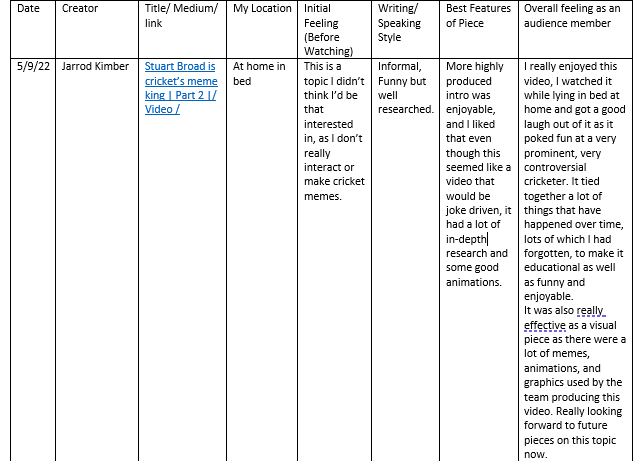
The reason that this process was designed and undertaken was to introduce and inform the niche to audiences who are new to cricket, or those who have engaged with the sport and its associated media and outlets. Components like the column for writing and speaking style were created to gauge a piece of content and its appropriateness for general or niche audience, with the prior knowledge of the viewers the main variable in question. This would allow me to associate the writing style to the content of the video; if it was something broad and introductory it would be for a general sporting or news consuming audience, whereas if it was full of data, analysis and jargon, appropriate to the expert eye or ear of a cricket enthusiast, then I would make a point to note it down. These self-aware decisions relate directly to principles of autoethnography, and assisted me in recognising and developing my persona as the process continued throughout the semester.
The above process was crucial in generating epiphanies and becoming more aware of my online persona within this niche. Online persona, described by IGI Global as “an expansion of your real-life identity. It is based on what you publish online, and it can shape other people’s perceptions of you,” became one of the more critical elements of my particular ethnographic study. Attempts were made to engage with each of Chris Moore’s five dimensions of persona; public, mediatised, performative, collective and value, over the course of the curation of this study. I began developing my audience-facing cricket media persona last year by beginning to write a blog, and am happy to put my name to my work in a professional sense within this micropublic. This aspect of my persona lends itself to mediatisation, where in previous subjects and in this one I have made either public or private media concerning my niche in order to develop my reputation as a creator or analyser of this media sphere and its many outlets. In terms of performativity, and the aim of combining “all the various characteristics that are staged and presented in the everyday and intended to interact with others”, I aimed to present myself not as a professional, but someone with a goal of becoming an expert in the field, and am willing to put my name to this work as part of forming an eventual online cricket writing persona of my own. Having said that, one of the crucial decisions within this project was to study instead of create content, as I didn’t feel I would be able to create anything that was both engaging and well-researched enough to add to the niche, particularly because the pieces I was looking to make would be 800-1200 words, or a 5-10 minute video, rather than something short. The collective component of online persona was evident in my research into a range of platforms. Despite starting on Substack, I ventured onto Twitter, YouTube, Patreon and onto major publications websites to help generate epiphanies and widen the research of my narrowed niche. Lastly, the value component relates also with performativity, as I intend to be taken on as professional or at least training to be professional in my ethnographic and cricket media related activities. By developing these elements of online persona, I was then able to develop skills, and epiphanies, that then gave further value and usefulness to the project as a whole once the semester came to an end.
With this study of persona, academic research and media within a niche, I have developed a range of soft and hard skills that relate to not only my professional future, but my abilities in terms of ethnography. My digital artefact has allowed me to use my hard skill of cricket knowledge, and combine it with soft skills such as work ethic and ambition to be a part of the media landscape of the sport in my future career. I feel that this has assisted me in continually studying throughout the semester, as I continually attempted to study this niche “consciously, emotionally, reflexively” to the best of my ability. This allowed for epiphanies to be made, particularly thanks to my study of the level of jargon or analysis in a piece. This allowed me to try and rank and determine appropriateness of content to an audience, and also gave me the realisation that watching cricket side-by-side with an analysis video running was something I was definitely interested in, and wanted to do again. However, being reflexive and conscious of other members of the niche, I recognised that not all consumers would be able to follow and engage with the content. That is where I would be cautious, as a creator, to produce content at certain levels, where the more analytical content is more engaged with, while the more basic information is communicated broadly. Another element that I found interesting was the relationship between engagement and location, where creators will look to whet, but not overindulge, the Indian or English markets, who have more consumers, and instead produce a good range of content for worldly fans to view. These epiphanies, and some others that were noted in prior media and in my digital artefact, bring me back to the strong relationship between the online world of media and sport that was highlighted in previously cited academic works, as well as the information on autoethnography and persona itself to create a method that allows for budding studiers of media, and in my case cricket media, to study not only the content, but themselves as they look to build towards a career in the niche. This reflexive and ever-adapting process will have to continue going forward, however these sensitivities should allow for greater awareness and therefore success in creating, and promoting content, based on the way in which these two multi-platform journalists approach their work. While I was aware of comments and interactions made by others users, as I showed in past blogs, I then decided to focus most on my own perspectives and sense-based ethnographies, in order to compile this report.
After being introduced to ethnographic and autoethnographic research methods for the first time as a part of this subject, I feel that the narrowing, study of persona and research methodology utilised here in my digital artefact has created a usable and easily communicated point of reference for those looking to study a media niche and then introduce it to a new audience. There were many cricket-specific elements of this process, but I feel that they could be transitioned, and I also feel that the soft and hard skills involved in compiling the blogs, artefact and final report of this Media Ethnographies study will have benefits of a professional nature going forward. To have begun with just cricket, then Substack, then exploring their fields with that niche platform as a base point, there has been a development across the board of ethnographic skills bought unto me by completing this subject and its related components throughout the semester.
References
https://journals.sagepub.com/doi/full/10.1177/2167479520979958
https://www.tandfonline.com/doi/full/10.1080/01292986.2017.1284876
 Russ Haylock Sportswriting