I, like many people my age (67%), have now been using Instagram for the majority of the last decade. It was one of the first programs to introduce me to social media, defined by Manning (2014) as “new forms of media that involve interactive participation”.But in using it to present my sense of self, I feel it has always been an authentic representation of myself. When I was younger I posted a lot more, as did my friends. Now I use it sparingly as a presentation of myself, I’ve made two posts in the last two years, but I use Instagram daily to interact with my friends and my interests. However, allowing me to make these two posts allows me to express myself just the way I want to. I’m happy, I’m present, but I don’t feel the need to post my breakfast on my story everyday.
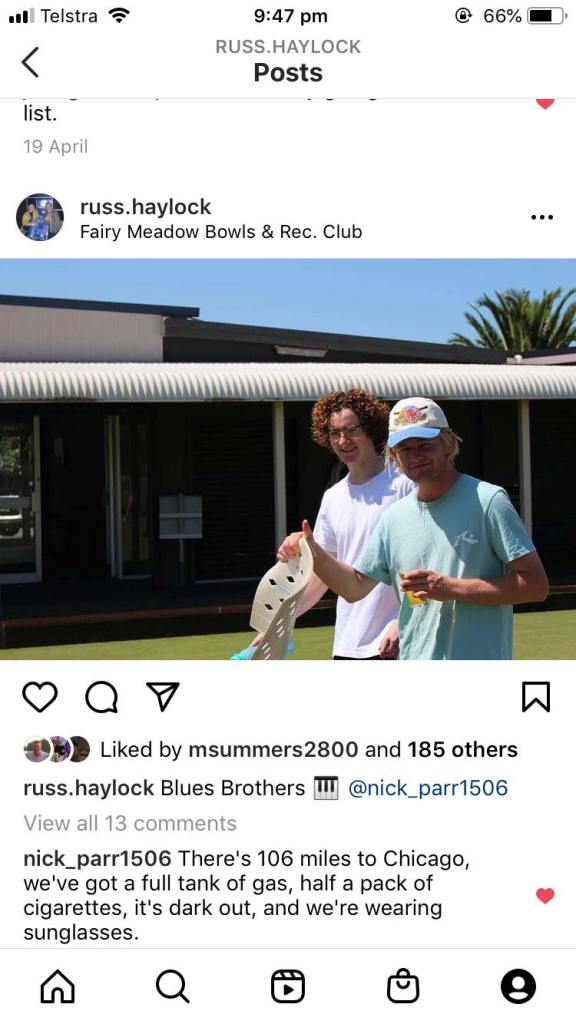
In establishing a more private sense of self, I find Instagram much more effective than other platforms. I enjoy the fact that if I want music posts, or sports posts, or literature posts, I’ll get them if I follow them, and these pages lead to other pages that form an imagined community (Anderson, 1983) within the platform that I enjoy being a part of. I’ll get a similar experience eventually on Facebook, but I’ll have to scroll past whatever my Aunty has been tagged in by a friend I don’t know first
In 2010 American company Aimia released a report attempting to define types of social media users. They came up with six distinct categories, and I feel that I best fit as an onlooker, defined as someone who “may lurk on several social media networks, but they post infrequently. They rely on social media primarily to keep up on the online lives of others within their social networks, but are reluctant to share details about themselves. Onlookers want complete control of their online information.”
My audience are my followers, but personally this figure doesn’t motivate me one way or another. My account is private, so it is accessible to whoever I want to be able to access it. I’m an outgoing person in real life but I prefer to be selective about who can see what I post, and certainly don’t post about things I’m not comfortable with. Thankfully I have friends, particularly my age, that make opinionated posts, and these allow me to do my own reading and make my own judgement on important issues.
Most scholars agree that “youth political and civic participation are crucial for the health and future of democracy and that social media can at least in theory play a major role in increasing and widening this participation.” (Leyva, 2016).
Thanks to generating a wide array of friends (or followers) over the years, I have become a part of an audience that transcends time and space and assists me in forming my opinions on what is going on around me in modern society, especially relating to issues such as the Black Lives Matter movement, climate change and mental health awareness. So, despite being something of an “onlooker”, this aspect of Instagram gives meaning to me, and makes it a viable medium for me to use going forward.
References
Leyva, R. 2016, ‘Exploring UK Millennials’ Social Media Consumption Patterns and Participation in Elections, Activism, and “Slacktivism”’, Middlesex University, (p. 464.)
Manning, J. (2014.) ‘Social media, definition and classes of. In K. Harvey (Ed.)’, Encyclopedia of social media and politics (pp. 1158-1162).
Social Media Perth, 2021, ‘Facts & Figures // Instagram Statistics for 2021’, viewed 28 August 2021. https://www.smperth.com/resources/instagram/instagram-statistics/#:~:text=3%2C100%2C000%20Australian%20users%20are%20aged,the%20most%20active%20age%20group.
Final Step Marketing, 2014, ‘The 6 Types of Social Media Users’, viewed 28 August 2021. https://finalstepmarketing.com/the-6-types-of-social-media-users/
 Russ Haylock Sportswriting