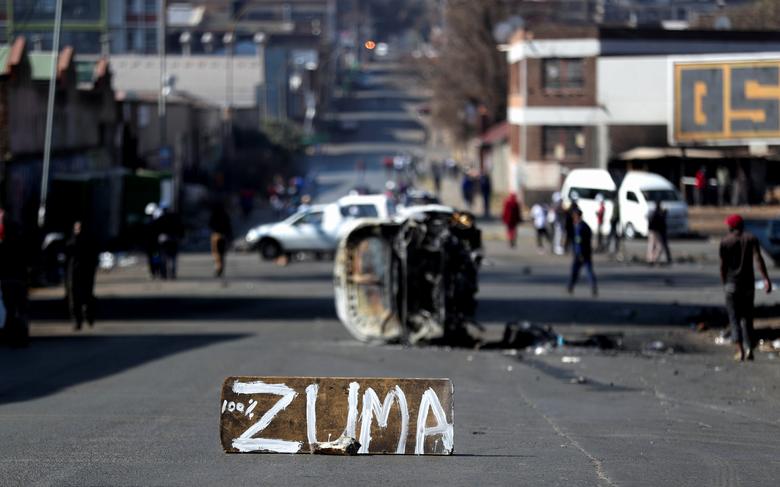
The recent protests in South Africa have put all aspects of citizen journalism under the microscope, as the imprisonment of former President Jacob Zuma in July 2021 led to widespread protests and looting in the Republic.
Citizen journalism is defined by Oxford as “the collection, dissemination and analysis of news and information by the general public, especially by means of the internet.” Further to that, Mutsviaro and Columbus (2012) noted that “citizen journalism in Africa plays an important role in providing counternarratives to mainstream professional media, which are often constrained by national governments.”
So was the social media driven citizen journalism in response to the President’s imprisonment good, bad or a bit of both? Here’s a bit of background.
Jacob Zuma served two terms as President of South Africa running from 2009 to 2018, representing the African National Congress (ANC). In late June he was sentenced to 15 months jail for refusing to appear at a corruption hearing that was investigating his term as President. He handed himself over to police on July 7, and once he was incarcerated widespread unrest inspired by his supporters broke out across the country, particularly in Kwa-Zulu Natal and Gauteng. In all 337 people connected to the unrest have died, while over 3,000 have been arrested.
Nine days after Zuma’s imprisonment South African journalist Karen Allen wrote in the Daily Maverick that “a dangerous information gap has been allowed to develop by the lack of timely, accurate public information from government sources. The traditional media’s ability to access unrest sites has also been limited, with journalists sometimes in danger. Social media platforms are filling that void, often with unverifiable content, much of it false. For a worried public desperate for news, the result can be an inflated reality shared via self-selected, trusted social media networks.”
As a result of this she suggests that “this may push the government to restrict social media use altogether or usher in punitive laws that constrain the democratic space.”
This relates back to Mutsivaro and Columbus’s studies of African citizen journalism. They note that “the assumption and viewpoint that trained journalists often fail to tell people’s real stories certainly has contributed to the rise of participatory journalism, whose presence has also been sustained by the consequent emergence of new media technologies.”
This is backed by a 2019 Reuters study that showed 51% of South African people don’t trust the news, and with lack of trust in media and lack of information from the government the public turned to use of social media.
The benefit of recording and posting scenes of looting and ransacking is that it draws attention from the world to not only the unrest but the social issues affecting South Africa, such as their record high unemployment rate of 32.6% (Reuters) and the World Bank findings that show South Africa is the most unequal country in the world. However, social media does have the ability to inspire and spread the violent behaviour that occurred and can become “weaponised” (Allen, 2021) with very dangerous physical and economic repercussions. Overall I believe this example of citizen journalism had a certain necessity and arose naturally given their lack of trust with traditional media, but may have caused more harm than good considering the events that played out and the potential to instigate violence and crime.
References
Mutsvairo, B & Columbus, S 2012, ‘Emerging patterns and trends in citizen journalism in Africa: The case of Zimbabwe’, Central European journal of communication, vol. 5, no. 2, pp. 121-135.
Allen, K. 2021, ‘Social media, riots and consequences’, Daily Maverick, viewed 16 August, 2021. https://www.dailymaverick.co.za/article/2021-07-16-social-media-riots-and-consequences/
Mabena, L. 2019, ‘Trust in independent media in South Africa under threat’, SABC News, viewed 18 August, 2021. https://www.sabcnews.com/sabcnews/trust-in-independent-media-in-south-africa-under-threat/
Scott, K. 2019, ‘South Africa is the world’s most unequal country. 25 years of freedom have failed to bridge the divide’, CNN, viewed 23 August, 2021. https://edition.cnn.com/2019/05/07/africa/south-africa-elections-inequality-intl/index.html
Reuters Staff. 2021, ‘UPDATE 1-South Africa’s unemployment rate reaches new record high in first quarter’, Reuters, viewed 23 August 2021, https://www.reuters.com/article/safrica-economy-unemployment-idUSL2N2NJ0NV
Reuters Staff. 2021, ‘Worst violence in years spreads in South Africa, Reuters, viewed 18 August 2021, https://www.reuters.com/news/picture/worst-violence-in-years-spreads-in-south-idUSRTXEAICM
 Russ Haylock Sportswriting