Coming from rural NSW I had a handful of news sources growing up. Mostly this came through the local papers, ‘The Land’, TV and the people around me. It was only when I got older and involved with more mediums that the net for the media I was taking in widened dramatically.
Most of the media I currently access relates to sport and local news. I use websites like ESPNcricinfo, owned by US based sporting broadcaster ESPN, in conjunction with Disney and Hearst Communications, and NRL.com, owned by the NRL itself, frequently.
I trust ESPNcricinfo greatly, as it employs and gives freedom to many of the top cricket journalists in the world, and NRL.com as it works alongside the Clubs and sponsors that create content for the page. These qualities matter to me in my hopes of becoming a sports journalist as they allow their writers to go about their work in a range of styles and angles.

I also put a lot of trust into local news. The newspaper for my area, The Monaro Post, is fully independent and operated by three local women, employing journalists, sales staff, and design staff across the region. As they have no overriding pressure to angle a certain way, they create content specific to my area that the community appreciates, making it a well-oiled news machine.
This source being a valid one is important to me, and I feel that the visibility and will to be upfront makes my local paper trustworthy, as they are active and informed in their own community.
In an interview with the ABC, veteran journalist and editor of the independent newspaper The Derwent Valley Gazette Roger Hanson says that “people in country areas have a voice and they have some fantastic stories, so who is the one to tell them?
“That is why local newspapers and local radios have a very important place in the (media) landscape today.”
I feel that areas that have ACM or Newscorp controlled media aren’t so lucky, and this filters from the furthest rural corners to the big cities.
The weight of press owned by these conglomerates and the number of mediums they can publish it through becomes overwhelming, and the statistics back up this admission.
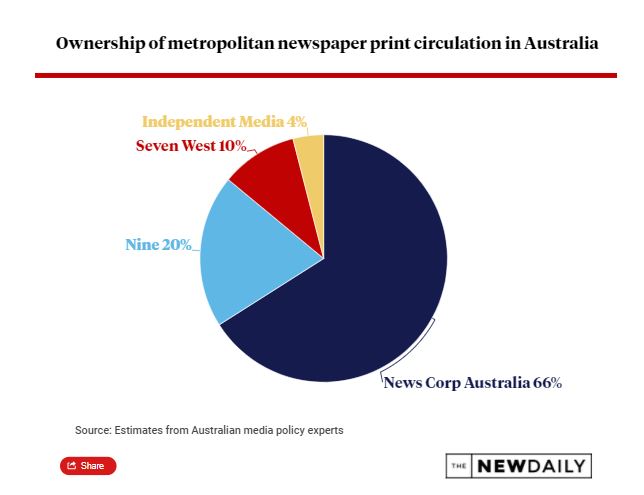
Dr Denis Muller is a senior research fellow at The University of Melbourne’s Centre for Advancing Journalism. Following the finalisation of the Morrison government’s new media bargaining code in February 2021, Dr Muller was quoted in The New Daily saying “It’s a problem for democracy, if you’ve got that level of power concentrated in so few hands.
“It limits the number of voices.”
This brings about skepticism for readers like myself, as we are forced to question the narrative that fits behind the stories printed around the country.
Coming back to Roger, who previously worked at the Newscorp owned Hobart Mercury as well as his current independent venture, he says “there’s a distinct separation between the publisher and the editorial content” in Newscorp papers, whereas in independent press “the story is there to be told, and we then tell the story.”
This develops trust in the area of the publication, something that local news readers, like myself, place higher than anything else when reading anything from the local rag to the biggest of media sources.
Font Public Relations (2019), Roger Hanson from The Derwent Valley Gazette on last night’s ABC News, July 8, 2019, available at: https://www.facebook.com/watch/?v=667352527025453
Dick, S. (2021), Why Australia’s media code is great for news giants, but not democracy, The New Daily, Available at: https://thenewdaily.com.au/news/national/2021/02/24/media-ownership-concentration/
 Russ Haylock Sportswriting